The Evolution Of Protective Shield Technology In Ancient Military Units
The Silent Guardian of Ancient Warfare
The history of warfare is essentially a perpetual race between the advancement of offensive weapons and the development of defensive measures. While sharp swords and piercing spears often grab the historical headlines, the true unsung hero of the ancient world is the defensive barrier carried by the frontline soldier. Understanding the evolution of protective shield technology reveals how ancient military units adapted to shifting threats, constantly refining how they held the line against overwhelming odds.
These early defensive tools were far more than simple planks of wood or scraps of metal. They represented the peak of ancient engineering, designed to save lives while enabling complex battlefield maneuvers. From the earliest days of organized combat, the way a civilization constructed its shields determined its ability to project power, survive ambushes, and dominate regional conflicts.
From Raw Materials to Engineered Defense
In the earliest stages of human conflict, the materials used for defensive gear were dictated purely by local availability. Early soldiers relied on basket-weave frames, sturdy wood, or hardened animal hides to deflect incoming projectiles and blows. These rudimentary shields were lightweight but lacked the structural integrity to withstand repeated, heavy impact from more sophisticated weaponry like heavy axes or metal-headed maces.
As metalworking techniques improved, the transition to reinforced shields began, marking a pivotal moment in the evolution of protective shield technology. Warriors started attaching bronze or iron rims to wood, or even plating the entire face of the shield with thin metal sheets. This added crucial durability, allowing for a much longer lifespan during grueling campaigns where equipment breakage could easily cost a soldier their life.
The Evolution of Protective Shield Technology in Classical Greece
The Greek phalanx is perhaps the most iconic formation in military history, largely thanks to the specialized design of the hoplite shield, known as the aspis. This large, circular, bowl-shaped shield was crafted primarily from wood and covered in a thin sheet of bronze, providing a robust defensive surface. Its design allowed it to be gripped firmly by the forearm, while the outer rim rested on the left shoulder, creating an overlapping wall of protection.
The weight and size of the aspis were intentional, turning the hoplite into a living tank within the tight confines of the phalanx. This shield forced the entire unit to act as a single, cohesive entity, as each soldier protected his own left side and the right side of his neighbor. The tactical dependency created by this specific technology directly influenced Greek social organization and the way they perceived civic duty, making the shield as much a political statement as a military asset.
Roman Ingenuity and the Iconic Scutum
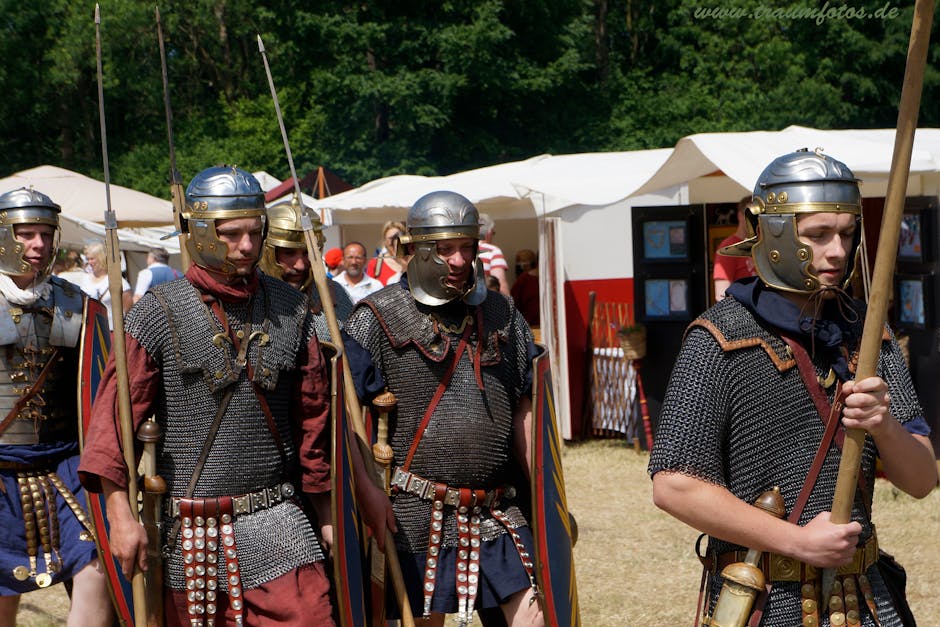
The Romans were masters of refining existing concepts, and their approach to the shield was no exception. They eventually replaced the smaller, round shields of their earlier years with the scutum, a large, rectangular, semi-cylindrical shield made of laminated wood and covered in leather. This design allowed the Roman legionary to crouch behind a nearly full-body defensive barrier that could easily deflect downward strikes and protect against projectiles.
The genius of the scutum lay in its curved surface, which allowed for a more efficient interlocking formation than the flat Greek shield. When legionaries locked their shields together in the famous testudo or tortoise formation, they created an almost impenetrable shell. This evolution of protective shield technology allowed the Roman military to methodically advance through enemy fire, completely changing the tempo and nature of siege and field warfare.

Tactical Versatility and Changing Shapes
Not all combat scenarios required a massive, heavy shield that sacrificed mobility for absolute protection. Light infantry, such as skirmishers or scouts, frequently used smaller, lighter shields like the peltast's pelta in Greece or various buckler-style shields in other cultures. These smaller tools prioritized maneuverability, allowing soldiers to dart in and out of the fight while still having a basic defensive option for deflecting missiles or glancing blows.
As cavalry warfare became more prominent, shield designs had to adapt further to the unique needs of mounted fighters. Mounted soldiers required a shield that did not impede their ability to steer their horses or swing their weapons. This led to the development of shields with different attachment points, often strapped to the arm rather than gripped by the hand, ensuring that the shield remained stable even during the chaotic movement of a cavalry charge.
Advancements in Materials and Craftsmanship
The constant pressure of war drove engineers to find lighter, stronger materials for shield construction. The use of multiple layers of thin wood glued together in alternating grain directions, a primitive form of plywood, was a brilliant innovation. This technique provided immense strength and resistance to cracking without adding the excessive weight of solid metal or thick timber.
Surface treatments also saw significant refinement, with many cultures using specially tanned, boiled, or reinforced leather to cover the wooden cores. This provided excellent shock absorption and prevented the wood from splintering upon impact. Some cultures, particularly those in the East, began incorporating intricate designs, metallic bosses, and even religious iconography, turning defensive items into expressions of status, unit pride, and psychological warfare.

Impact on Ancient Military Tactics
The continuous improvement of shield technology had profound implications for how battles were fought and won. Because shields were often the deciding factor in survival, they forced commanders to think in terms of formations rather than just individual combat. The following list highlights key tactical shifts driven by defensive advancements:
- Enhanced formation density: Stronger shields allowed soldiers to stand closer together, maximizing the defensive potential of a dense infantry line.
- Improved siege capabilities: Specialized, larger shield designs enabled armies to approach fortifications under sustained missile fire with minimal casualties.
- Increased specialized units: Diverse shield types facilitated the rise of distinct unit roles, such as heavy infantry, light skirmishers, and specialized flankers.
- Psychological dominance: Large, uniform shields created a visual wall that could break the morale of less-equipped or less-organized opponents before a single blow was struck.
The Lasting Legacy of Ancient Defense
When looking at the arc of history, it is clear that the humble shield was far more than a piece of wood or metal. It was a catalyst for organizational innovation, a focal point for materials science, and the foundational element of battlefield tactics for millennia. The relentless drive to improve this equipment transformed how ancient civilizations viewed both the individual soldier and the military unit as a whole.
While modern technology has moved far beyond the handheld shields of antiquity, the principles of layering, material science, and the integration of defensive tools into tactical formations remain highly relevant. Studying the history of these ancient protectors provides a deeper appreciation for the ingenuity required to survive on the battlefield long before the age of gunpowder and modern armor.